LIXIANGs BIO
LIXIANG

BIO

LI XIANG / Personal statement & research context

01 / Education & professional experience

Environmental design → Information art and design → Interdisciplinary practice

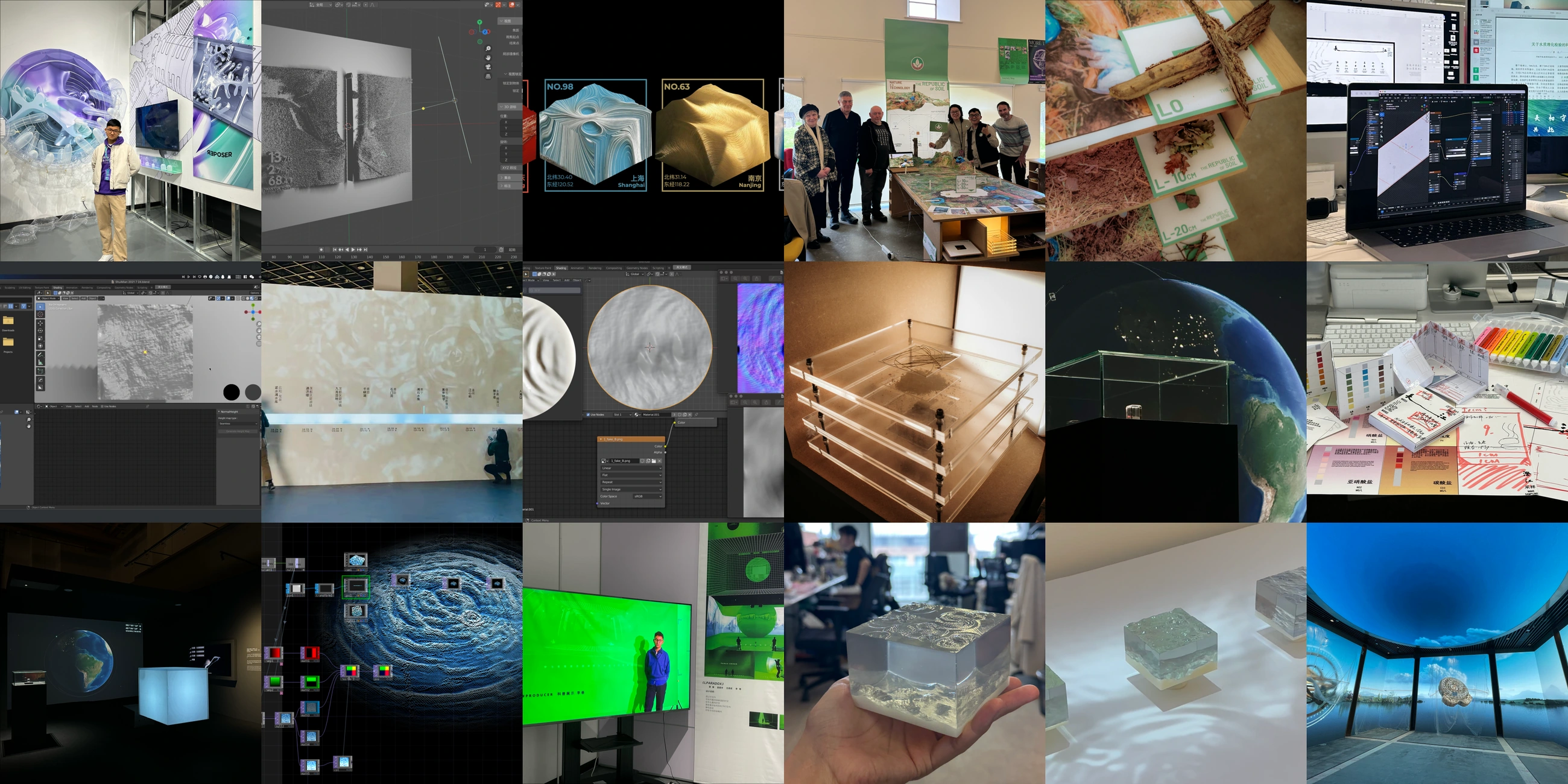
I am Li Xiang, a member of the Communist Party of China. I studied Environmental Art Design at Shandong University of Art & Design as an undergraduate, followed by graduate studies in Science Communication Exhibition Design at the Academy of Arts & Design, Tsinghua University. After graduating in 2023, I joined Tsinghua University's Future Laboratory as a research assistant, focusing on the research groups “Intelligent Scenarios for Ecological Data Perception” and “Space Art and Design.” I am currently a doctoral student at the Academy of Arts & Design, Tsinghua University.

My undergraduate studies gave me a solid foundation in environmental design and the skills to create interior environments. For my graduation project, I embedded the functions of everyday service applications within a disused factory, bringing new life to an old building. I completed my undergraduate studies with excellent results.

During my graduate studies, as a Master of Fine Arts student in the Science Communication Creativity and Design programme, I combined rigorous scientific knowledge with spatial interactions that brought physical and digital experiences together. I actively expanded my theoretical and practice-based research, taking part in several funded research projects and design practices.

At Tsinghua University's Future Laboratory, I continued the research directions developed during my studies. Working with a multidisciplinary team, I undertook further creative projects and research at the intersection of art and technology. I also helped plan and organise academic conferences and thematic exhibitions on several occasions, and served in university community roles, including as a Party-building assistant. I assisted with interdisciplinary teaching and research projects in the Department of Electronic Engineering and the Academy of Arts & Design.
02 / Current research: framework

Real environments → Integration of physical and digital space + Innovation across art and science

Starting from my background in environmental art design within real environments (A), I focus on interactions between people and space across multiple media. These interactions offer ways to perceive large-scale, changing and even extreme ecological conditions, renewing our awareness of real environments. In my research, I integrate physical and digital spaces through spatial design (B), while approaching interactive art installations and the artistic expression of data through artistic innovation (C). By bringing artistic innovation together with environmental science, I aim to develop new scenarios that connect physical and digital experiences and work across art and technology. I hope to offer the public more engaging, immersive ways to perceive the environment.

Research framework: real environment, spatial design and art innovationSpatial design (B) and art innovation (C) form two vertically overlapping circles, with real environment (A) at their intersection. Spatial design connects digital and physical space; art innovation connects scientific environmental data and interactive art installations. The two directions are spatial experience design integrating physical and digital, and environmental science and art innovation.1 Spatial experience designintegrating physical & digital2 Environmental science& art innovationSpatialdesign(B)Realenvironment(A)Artinnovation(C)Digital space >< Physical spaceScience >Environmental data< ArtInteractiveinstallations

03 / Research direction: spatial experiences integrating physical & digital

In my professional practice, I focus on integrating virtual and physical spaces at the sensory level. My research explores spatial interaction, immersive experience design and seamless transitions between virtual and physical environments. I investigate two directions in particular: the visual integration of physical and digital space, and spatial narrative. Through these, I seek to advance innovation and open new possibilities in spatial design.

04 / Research direction: environmental science & artistic innovation

During my studies, I bring environmental science and art together, using interdisciplinary methods to find new ways of expressing scientific concepts. Drawing on environmental science research, including climate change and biodiversity conservation, I communicate complex environmental issues through artistic creation and interactive installations. I seek to extend the scope of artistic expression while offering new perspectives for communicating environmental science.

05 / Disciplinary understanding & personal practice

As my study and practice in art, design and theory have deepened, the encounter between my environmental design background and practices that integrate art and science has prompted new interdisciplinary thinking. My recent research and practice focus on the cross-disciplinary application of information and interactive art to public science communication. I seek to use digital experiences to extend perception within the limits of physical space. This is expressed particularly in my research on “the artistic expression of ecological data as an extension of human perception,” through which I have undertaken preliminary exploration and investigation of three propositions:

• Ecological and environmental big data, used with technological tools, can create mirrored models of the environments in which we live. • Combining digital art and data science can offer a pioneering way to experience ecological environments. • Ecological data artworks can heighten sensory sensitivity, making ecological issues that were previously ignored or imperceptible visible and tangible.

06 / Graduate practice: data-driven participatory ecological science communication

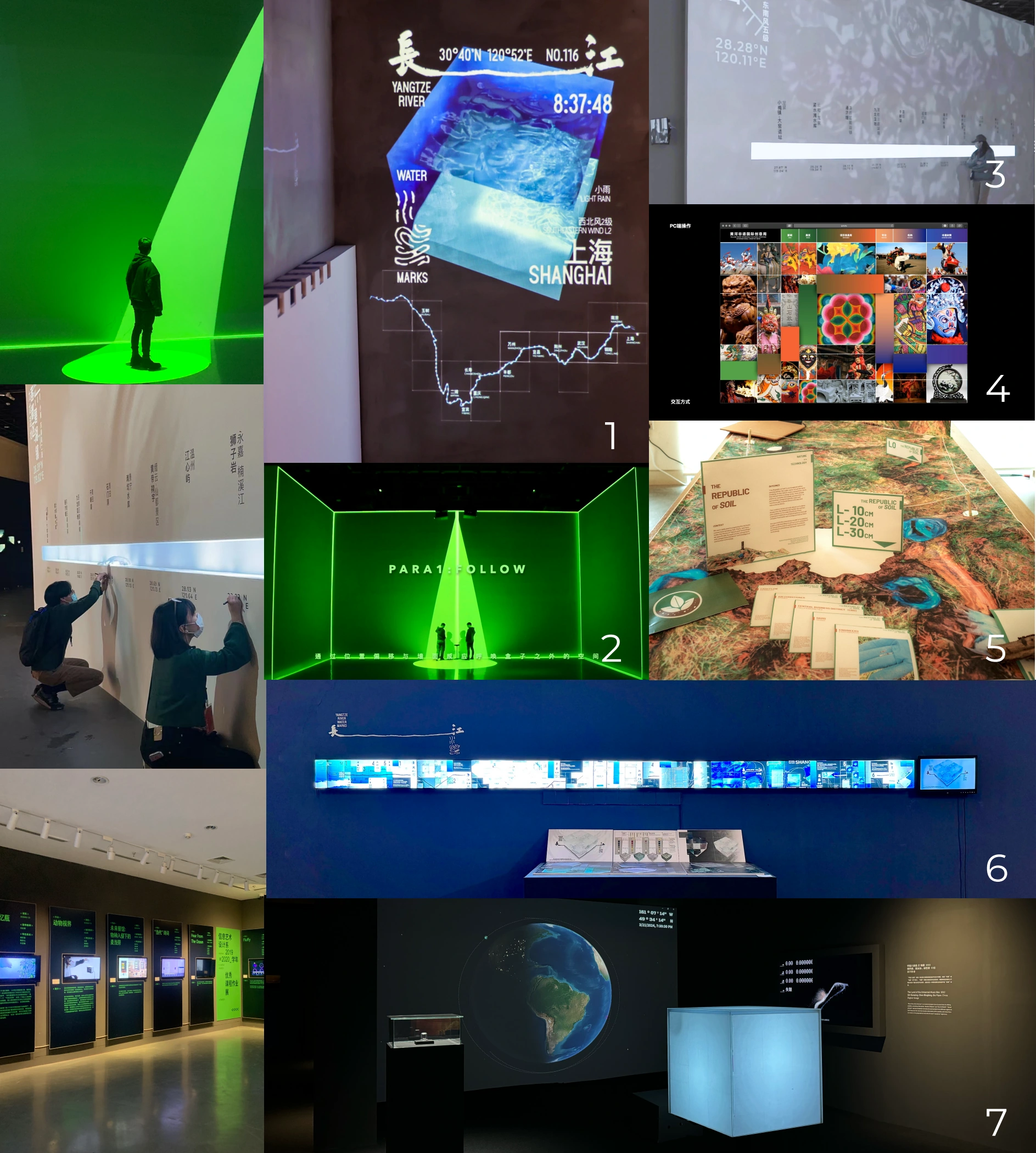
At the completion of my graduate studies, my project “Data-Driven Participatory Ecological Science Communication: Real-Time Water Quality in the Yangtze River” explored three approaches. Together, they offered a practical possibility for virtual, real-time science exhibitions, as well as new ideas for remotely co-created digital art experiences and physical digital artworks:

• Investigating how data visualisation and multisensory translation can overcome the limits of human perception, allowing the public to perceive environmental issues more directly through artistic experiences and thereby supporting science communication. • Using participatory citizen science activities as a method of public engagement. Drawing on open-source weather platforms and collected data, I used real-time rendering to develop an interactive platform for experiencing Yangtze River water-quality data artistically and in real time. • Creating a series of physical digital artworks through data physicalization, using data-driven methods, 3D printing and reward mechanisms to strengthen ecological awareness and public participation.

07 / Future exploration: digital presence & physical reality

A sustainable future: physical data art + Digital immersive spaces → Reflecting real environments

Innovative expressions of data are common in digital art. But how can a “digital presence” be made tangible and embodied within “physical reality”? Against the combined backdrop of an intensifying environmental crisis and rapid advances in digital technology, two questions have become challenging and thought-provoking research topics: how can digital art take an effective physical form within natural environments and encourage everyone to care for ecological systems (D)? And how can digital ecological environments faithfully reflect real environments that are continually changing (E)?

Exploration framework: data physicalization and space digitizationTwo dashed circles extend the original vertical framework: data physicalization (D) on the left and space digitization (E) on the right. Digital space and scientific environmental data feed physicalized digital art; physical space and interactive art installations feed digitized immersive experiences. Both point toward the real environment.SpatialdesignArtinnovationRealenvironmentData(D)PhysicalizationDigital artSpaceDigitization (E)ImmersiveexperienceDigital space >< Physical spaceScience >Environmental data< ArtInteractive installations

08 / Exploratory overview: media & our relationship with nature

Digital art driven by ecological data should be more than a tool for visualising that data. It should also create a bridge for two-way interaction with real natural environments. As Marshall McLuhan argued through the proposition “The medium is the message” in Understanding Media: The Extensions of Man (1964), the form of a medium profoundly affects how information is received and understood. Yet, in an age of information overload and proliferating virtual experiences, can digital art truly inspire a deeper understanding of nature and action to protect it? Can this form of artistic intervention create a meaningful connection between people and natural environments, or might it deepen their separation?

09 / Exploratory overview: immersion beyond sensory experience

As a way of presenting digital art in real space, immersive experience encourages people to focus on a particular situation, finding pleasure and satisfaction within it while setting aside their everyday surroundings. Sensory and cognitive experiences create a sense of immersion through an alternation of intense positive and negative emotions. In the foreseeable future, we will encounter experiential art forms that extend beyond conventional visual experience. However, overemphasising pure sensation and superficial artistic effects can also become a “trap.” Any medium is only a supporting means of opening up immersion. Digital artworks that have depth and integrate physical and virtual elements with real worlds, events and environments can offer a more profound sense of immersion.

10 / Exploratory overview: ecological noetic networks & public participation

There is also an urgent need to explore how public communication can achieve greater reach and depth. In creating digital art, we should consider not only the expression of ecological data but also the breadth of knowledge it covers, the audiences it reaches, the depth of understanding it supports and the sustained engagement it encourages. In this way, it can cultivate ecological awareness and, in turn, shape ecological behaviour. In his discussions of networked art, Roy Ascott proposed the concepts of “Super Thought” and “Noetic Networks,” emphasising new spaces of consciousness created through the integration of individual neural networks and global networks. This perspective prompts a question: could digital art based on ecological data be understood as an “ecological noetic network,” in which individuals and nature form a new, participatory relationship through digital media? Within such a process, ecological data would no longer be static information communicated to the public in one direction. Instead, it could become a dynamic body of knowledge that people interact with, perceive and help construct.

11 / Research plan: proposed topic & overview

Proposed topic: Sustainability Research into Immersive Ecological Data Experiences and Public Communication Design.

Drawing on practices in spatial experience design and innovation in art and design, this research will investigate how interaction and information design can transform multidimensional ecological data—such as biodiversity, pollution dispersion and climate change—into immersive experiences within dynamic art installations. It will also explore how interactive mechanisms can improve ecological conditions at the sites where data are collected, supporting public communication and environmental awareness. The research aims to develop digital art centred on ecological data that can “connect the public online” and “give back to the environment offline.” In doing so, it seeks to advance ecological conservation and sustainable development practices, opening a new field with both artistic and scientific value.

12 / Research plan: framework & ecological value chain

Ecological data → Immersive experience → Public communication → Ecological feedback

In recent years, many new-media artists have used interactive artworks to call attention to environmental issues such as global warming and carbon neutrality. However, converting ecological data into immersive artworks remains relatively inefficient (A). Although immersive experiences can generate practical benefits, their site-specific nature, high costs and difficulty of replication limit their wider dissemination (B). There is also a lack of established approaches combining physical spaces with remote experiences (C), and a pressing need for practical examples that make a tangible contribution back to ecological systems (D).

This research into immersive ecological data experiences and public communication design aims to use online and offline interaction to turn digital artworks into an “ecological value chain” that originates in nature and replenishes it. This is a proposal for a new form of ecological art. It uses real-time ecological data extracted from the physical world to create digital art, generating both value and potential for dissemination. Through the artistic design of communication platforms and game mechanisms, participants can experience environmental and ecological changes and ultimately give something back to nature. This would create a beneficial cycle between “virtual” and “real” worlds, generating new ecological value and social meaning.

Ecological value chain: ecological data, immersive experience, public communication and ecological feedbackEcological data flows through immersive experience and public communication to ecological feedback, returning through the real environment to form a loop. A relates to science and ecological environmental data; B to design and physical–digital space; C to art and interactive communication installations; D marks the feedback loop to the real environment.Real environmentEcologicaldataImmersiveexperiencePubliccommunicationEcologicalfeedback(A)(B)(C)(D)ScienceDesignArtEcological–environmentaldataPhysical–digital spaceInteractive communicationinstallations

13 / Research plan: significance

In recent years, China, as the world's largest energy consumer, producer and importer, has faced a new wave of energy technology innovation that challenges the foundational position of conventional energy. Green and low-carbon development has become the dominant direction for energy development. At the same time, China faces the world's largest energy-related environmental challenges and is its largest greenhouse gas emitter; at the time of this statement, its emissions had not yet peaked. The era of carbon-peaking and carbon-neutrality goals brings new industrial structures, consumer demands and ways of life, while governments around the world introduce policies to support green and low-carbon transitions. During this process, vast amounts of environmental and ecological data record efforts to improve natural environments. These efforts often remain invisible; digital art can turn them into explicit, intuitive forms of expression.

14 / Research plan: innovation & remote presence

Digital art and exhibition technologies can provide a “selective liberation” of natural data from physical constraints. They can simulate certain spatial and temporal limits of the real world while transcending others. By using actual geographic coordinates as links and combining online and offline interaction, they can create new experiences of remote presence. Through processes of movement, transformation and connection, ecological digital artworks can become digital value that is tangibly returned to real environments. This can form a closed cycle that draws from nature and gives back to it. On a psychological level, it can support interaction and understanding, strengthening participants' sense of presence, identity and fairness in the process of environmental protection.

15 / Related research & cases: artistic translation of ecological data

As information-gathering technologies advance, ecological data in China and elsewhere are becoming increasingly real-time and diverse. They are used primarily for purposes such as remotely observing animal migration and managing large-scale environmental conditions. Open, collaborative data platforms are growing in the field of animal monitoring. In bird research, for example, platforms such as eBird, Movebank and the China Birdwatching Record Centre share bird data to encourage collaboration, data openness and conservation, while supporting researchers and the design of user-friendly data platforms. Environmental and ecological observation frequently relies on weather satellites and GPS satellites for monitoring and positioning. For instance, a wind-resource estimation platform developed by the US company AWS Truepower obtains average wind speeds through environmental monitoring and uses colour gradients to visualise geographic locations, vegetation, buildings and other information.

But how can such data contribute to public communication about environmental protection? Working with ecological issues, digital-media artists can use ecological data as raw material, cleaning and reorganising it to translate complex, real-time and abstract information into artworks that can be read, felt and shared.

16 / Case studies: visualising ecological data at a macro scale

With growing demand for interdisciplinary data integration and advances in big data and digital technology, international large-scale scientific programmes such as Deep-time Digital Earth (DDE) are bringing together global geoscience data to support data-driven discovery. An interactive WebGL website presents four major dimensions of Earth's evolution across geological time: the evolution of materials, life, geography and climate, collectively referred to as the 4E. However, the platform is oriented more towards presenting scientific results. Its use of coloured point-based legends does not necessarily help viewers understand the processes of evolution more clearly.

By contrast, Earth Nullschool, a WebGL-based visualisation of global weather conditions created by Cameron Beccario's team during 2017–2020, uses supercomputing forecasts to present ocean surface currents, sea surface temperatures and near-surface winds over land, updated every three hours. Real-time moving streamlines reveal otherwise invisible, macro-scale states of wind and water, creating a more aesthetically engaging interface with stronger potential for public education.

17 / Case studies: making ecological data perceptible

In Wind of Boston, Turkish new-media artist Refik Anadol transforms the invisible winds of Boston and its surroundings into “data paintings.” He collected a year's worth of wind direction, wind strength, temperature and humidity data from Boston Logan International Airport, combining them with urban layouts and architectural models to create a distinctive visual expression. An otherwise invisible, city-scale “windscape” becomes an intuitive digital panorama.

Wind Map, created by data visualisation and analysis pioneers Fernanda Viégas and Dr Martin Wattenberg, uses wind monitoring and forecast data from the US National Digital Forecast Database. Its real-time trailing effects generate a series of digital artworks resembling animated black-and-white prints. Through this artistic expression, viewers encounter national wind patterns anew, in the form of visually distinctive “portraits.”

18 / Case studies: connecting immersion with real environments

When people think of “immersive experience,” the first image that comes to mind is often a fully enclosed new-media space created through sound or projection. In practice, however, many artists work within real settings. They use local landscapes and the unexpected presence of exhibited objects to draw people into a state of flow that takes them beyond their immediate surroundings, creating a particular kind of appeal.

Real settings and immersion can produce a dual sensory impact. In the 2019 exhibition Ice Watch by Olafur Eliasson, actual blocks of ice from Greenland's glaciers were transported to a city square. Visitors could touch the melting ice and directly experience the effects of climate change. The work draws not only on the unexpected presence of a “foreign object” in physical space, but also on interaction with real material to intensify both sight and touch. It creates an immersive sensory encounter through which visitors can feel the urgency of the ecological crisis more directly.

In teamLab's 2020 exhibition Resonating Life in the Acorn Forest, the team used interactive light and sound technologies to simulate changes in a forest ecosystem, allowing visitors to experience the fragility and beauty of ecology within a dynamic virtual nature.

19 / Case studies: immersive experiences across platforms

As digital technology advances, immersive experiences are reaching audiences through increasingly varied and widespread channels. For example, The Great Barrier Reef VR, launched in 2018 through a collaboration between David Attenborough and National Geographic, uses virtual reality to take viewers into the underwater world and explore the ecological crisis facing coral reefs. Audiences can experience it through VR equipment and share their experiences with others through online platforms. This digital form of communication expands the exhibition's reach, allowing more people to learn about ecological environments. The spread of social media and user-generated content (UGC) also creates new possibilities: visitors can share their immersive experiences through videos and photographs, helping exhibitions circulate rapidly around the world.

Social media and the sharing of digital content offer further opportunities for dissemination. Videos, photographs and live sharing can bring immersive exhibitions to wider audiences. For instance, the US innovative art space and immersive interactive exhibition ARTECHOUSE uses augmented reality (AR) to allow visitors to capture and share their interactions on mobile phones, gaining rapid visibility on social media. This approach extends exhibitions beyond conventional geographic and temporal limits. It also encourages visitors to become content creators and communicators in their own right, further increasing the impact of immersive experiences.

20 / Case studies: remote participation at a micro scale

Exhibition platforms and commercial models for multi-user remote interaction.

As early as 1995, artists and scientists were exploring mechanisms for remote interaction involving multiple online participants. Created by US interdisciplinary practitioners Ken Goldberg and Joseph Santarromana, Telegarden is an art installation that allows internet users to view and interact with a distant garden of living plants. Any online user can plant, water and monitor seedlings through the gentle movements of an industrial robotic arm. More than 9,000 members took part in cultivating the garden during its first year.

21 / Case studies: ecological awareness at a macro scale

EARTH 2050, a WebGL website created for Kaspersky's twentieth anniversary, explores how big data can inform environmental judgements about the plausibility of future ways of living. It foregrounds “predictions” about the development of cities around the world and the unfamiliar ecological environments and living conditions that people may encounter. The project team collaborates with numerous futurists and consults researchers, artists and scientists to develop well-founded perspectives.

Through open browsing and commenting, the website creates a “future twin” of the present-day Earth and explores predictions for different cities and countries. It includes 360-degree panoramas of various cities in 2040 and 2050, created by digital artists from different countries in response to ideas contributed by online users. Participants can also vote in support of, or against, other people's views. As a long-term project, it has involved many prominent futurists and specialists in further research based on these projections.

22 / Case studies: participatory interaction & ecological feedback

Many examples of ecological digital art still remain at the stage of visualising and artistically presenting real data. Yet, as value is created through digital art, virtual transactions and related contexts, could game or reward mechanisms bring the value of ecological data artworks into everyday life? Could they even give something back to the sources from which the data were collected, making the entire artistic process a closed cycle that produces greater social benefits and environmental outcomes?

23 / Case studies: linking low-carbon consumption with tree planting

Ant Forest is a public-benefit initiative launched by Alipay in 2016. Users who enable the feature can accumulate virtual energy by carrying out activities through Alipay, such as online and offline payments, online ticket purchases, utility bill payments and bus travel. Once enough energy has accumulated, users can claim a virtual sapling corresponding to that amount. After a user plants the sapling on their device, Alipay and its partner teams plant a real tree in an area in need of environmental improvement, potentially thousands of kilometres away.

24 / Summary & outlook

In summary, advances in information-gathering technologies are making ecological data increasingly real-time and diverse, providing new tools for environmental protection and scientific research. However, further exploration is needed into how these data can contribute to artistic, immersive experiences and communication approaches that invite participation from the wider public.

The cases discussed above also show the variety of methods available, from macro-scale ecological data visualisation to artistic data translation. Immersive experience has become a new approach to environmental education. By combining site-specific creation in real settings with remote interaction and other technologies, artists can develop more immersive, memorable multisensory experiences. In the future, further interdisciplinary work and interactive platforms will encourage public participation and strengthen ecological awareness and action.

LI XIANG李巷
© LIXIANG2020–NOW